
60 Degrees in January? How the 2026 "Snow Drought" is Heating Up High Desert Real Estate
The 2025/2026 Winter Transition in Central Oregon: Climatological Divergence, Recreational Adaptation, and Real Estate Market Resilience
The winter season of 2025/2026 has emerged as a landmark period of transition for the High Desert region, particularly within the interconnected economic and social hubs of Bend, Sunriver, and La Pine. Historically, the identity of Central Oregon during the winter months has been inextricably linked to the presence of a robust, reliable snowpack that fuels a multi-million dollar recreation industry and maintains the region’s long-term water security. However, the current cycle has deviated profoundly from these established norms, characterized by a significant "snow drought" and thermal anomalies that have forced a reevaluation of the regional economic engine. For real estate professionals and stakeholders, this meteorological shift is not merely a matter of seasonal weather but a fundamental driver of buyer behavior, inventory dynamics, and lifestyle marketing in a post-pandemic era.
The Historical Baseline and the 2025/2026 Meteorological Anomaly
To understand the magnitude of the current winter’s departure from the norm, it is necessary to examine the historical climatological record for Deschutes County. Central Oregon typically experiences a winter defined by consistency and variability, where snow falls, melts slightly in the daytime sun, refreezes overnight, and is topped up by the next system. February is traditionally the snowiest month of the year in Bend, averaging approximately 6.65 inches of snow over eight snowfall days. In extreme years, such as 2019, the region has seen as much as 46 inches of snow in a single month, with individual storms delivering over 12 inches in 24 hours.
The 2025/2026 season was initially expected to align with a weak La Niña event. Historically, La Niña conditions—characterized by cooler-than-average sea surface temperatures in the central and eastern equatorial Pacific—favor above-normal snowfall and snowpack for the Cascade Range. Meteorological forecasts early in the season suggested that while climate change has made reaching above-normal snowpack more difficult, the La Niña signal would still provide a favorable environment for winter sports. However, the actual performance of the 2025/2026 winter has been defined by a transition toward ENSO-neutral conditions and a persistent high-pressure ridge that has diverted the traditional "atmospheric rivers" away from the Deschutes Basin.
| Meteorological Metric | Historical February Median (Bend) | 2025/2026 Actual/Observed (Bend) | Variance |
| Average High Temperature | 39°F – 42°F | 45°F – 60°F | +6°F to +18°F |
| Average Low Temperature | Mid-to-upper 20s | 30°F – 34°F | +2°F to +6°F |
| Median Snowfall (Monthly) | 6.65" | < 2.5" (as of mid-Feb) | -62% |
| Snowfall Frequency | 8.3 Days | 2-3 Days | -64% |
Data synthesized from regional weather history and current airport observations.
This thermal divergence reached a peak in January 2026, when temperatures in Bend surpassed 60 degrees Fahrenheit, a figure more reminiscent of mid-April than mid-winter. This heat, combined with a severe lack of precipitation, has resulted in what federal monitors describe as the lowest February 1 snow cover in the MODIS satellite record, which dates back to 2001. Statewide, Oregon has reported record-low snowpack, with 86% of monitoring stations in a state of "snow drought" as of early February.
The Mechanics of the 2026 Snow Drought
The term "snow drought" refers to a period of abnormally low snowpack for the time of year, a condition that has profound implications for water supply planning and wildfire risk. In 2026, the drought was exacerbated by an elevational gradient: while some snow remained present at the highest peaks of the Cascades, lower-elevation areas experienced rapid melting or a total lack of accumulation. By February 1, 2026, critical basins including the Deschutes, Humboldt, and Upper Colorado were experiencing severe deficits, with snow water equivalent (SWE) values often falling below 50% of the historical median.
| SNOTEL Basin Update (Feb 21, 2026) | Median Peak SWE (in) | Current SWE (in) | Percent of Median |
| Owyhee Basin | 15.4" | 3.5" | 23% |
| Malheur Basin | 11.0" | 4.2" | 38% |
| Grande Ronde / Powder | 20.6" | 9.8" | 48% |
| Umatilla / Walla Walla | 19.0" | 7.3" | 38% |
Data provided by the NRCS Oregon SNOTEL Snowpack Update Report.
The underlying cause for this deficit was a combination of a weak La Niña that failed to deliver consistent moisture and a warming trend that has seen a majority of winters since 2010 fall into the warmest third of all recorded winters. While the National Oceanic and Atmospheric Administration (NOAA) noted that La Niña officially emerged in September 2025, its impact was limited by its weak intensity and the encroaching influence of ENSO-neutral conditions by the first quarter of 2026.
Impact on Winter Recreation: Alpine, Nordic, and Motorized
The recreational economy of Central Oregon is built upon the reliability of winter snow. When that reliability is compromised, the effects ripple through resort operations, gear rentals, and the broader hospitality sector.
Alpine Skiing and Resort Operations
Mt. Bachelor, the primary driver of winter tourism in the region, has faced a challenging but operational season. As of February 19, 2026, the mountain reported a base depth of 44 inches and a season total of 122 inches of snow. While these numbers would be considered healthy in many parts of the world, they represent a significant deficit compared to Mt. Bachelor’s average annual snowfall of over 462 inches.
The third week of February provided a critical "late-season respite," with a 17-inch dump of snow that allowed local ski areas to improve their offerings. Hoodoo Ski Area, which had struggled with coverage for much of January, was able to reopen on February 19, 2026, with a base depth of 28 inches after receiving 10 inches of new snow during the week. Similarly, Willamette Pass Resort reopened on February 20, though its base depth remained a precarious 12 inches.
| Ski Resort | Base Depth (Feb 2026) | Season Total (Feb 2026) | Operational Status |
| Mt. Bachelor | 44 inches | 122 inches | Open Daily |
| Hoodoo Ski Area | 28 inches | 92 inches | Open (Limited Grooming) |
| Willamette Pass | 12 inches | 44 inches | Reopened Feb 20 |
Data compiled from resort mountain reports and regional journalism.
Despite the fresh snowfall in late February, the long-term forecast for the final week of the month predicted highs in the 50s and sunny days, which resort operators noted "doesn't look promising" for maintaining the newly bolstered base. This volatility has changed the "rhythm" of the ski season, moving it from a steady, reliable period to one of opportunistic windows and high-elevation dependency.
Nordic Skiing and Snowmobiling Challenges
The Nordic and snowmobile communities, which often operate at lower elevations than alpine resorts, have borne the brunt of the warm winter. Virginia Meissner Sno-Park and Dutchman Sno-Park have seen highly variable conditions. While Dutchman Sno-Park has retained the most consistent snow coverage for Nordic skiers and snowshoers—offering 2 to 3.5 miles of ungroomed outings—other areas have faced frequent closures.
The Moon Country Snowbusters and the La Pine Lodgepole Dodgers, the volunteer organizations responsible for snowmobile trail grooming in the region, have had to suspend operations multiple times due to warm weather. Grooming is typically conducted during freezing hours to preserve the base, but when daytime temperatures reach 50 or 60 degrees, the machinery can actually cause more damage than benefit.
In addition to weather-related issues, specific trail closures have impacted the snowmobile network. The Newberry #2 Snowmobile Trail, a vital artery south of the Newberry National Volcanic Monument, was closed from December 2025 through April 15, 2026. This closure was not due to lack of snow but was implemented by the Deschutes National Forest to protect public safety during active geothermal operations in the area. Such closures, combined with the lack of snow at lower elevations like Crescent Lake Sno-Park, have compressed winter recreation into a smaller geographical footprint, increasing user density in the few viable areas remaining.
The Pivot to Alternative Recreation: Hiking and Biking in Winter
The defining feature of the 2025/2026 winter has been the widespread adoption of "summer" activities during months that are typically reserved for snow sports. This adaptation has been a boon for local retailers who stock hiking and cycling gear, and it has provided a unique marketing angle for real estate agents highlighting the region’s year-round accessibility.
Winter Mountain Biking and Fat Biking
The Phil’s Trail network, a world-class mountain biking destination west of Bend, has seen unprecedented winter usage. While lower sections like Ben’s Trail and Kent’s Trail have struggled with the "freeze-thaw cycle"—where muddy sections become frozen ruts that are dangerous to ride—higher sections have remained surprisingly "primo".
Trail reports from February 2026 highlight the shift in usage:
-
Phil’s (Lower): Reported as having "Prevalent Mud" in early February, with trail advocates advising riders to stay off to avoid permanent damage to the trail bed.
-
Ticket to Ride: Described as "Dry" and ideal in late January, as its sandy soil and exposure allow for quick drainage during warm spells.
-
Deschutes River Trail: Riders reported "Ideal" conditions in mid-February, with only a few muddy spots between Sunriver and Benham Falls.
Fat biking has also emerged as a strategic alternative. At Wanoga Snow Play Area, the "3 PSI Short Loop" has become a staple for winter cyclists. The Central Oregon Trail Alliance (COTA) has emphasized strict trail etiquette for these users, including the requirement for tires 3.8 inches or wider and low tire pressures (around 4 PSI) to ensure the soft snow is not rutted for other users.
The Unprecedented Winter Hiking Season
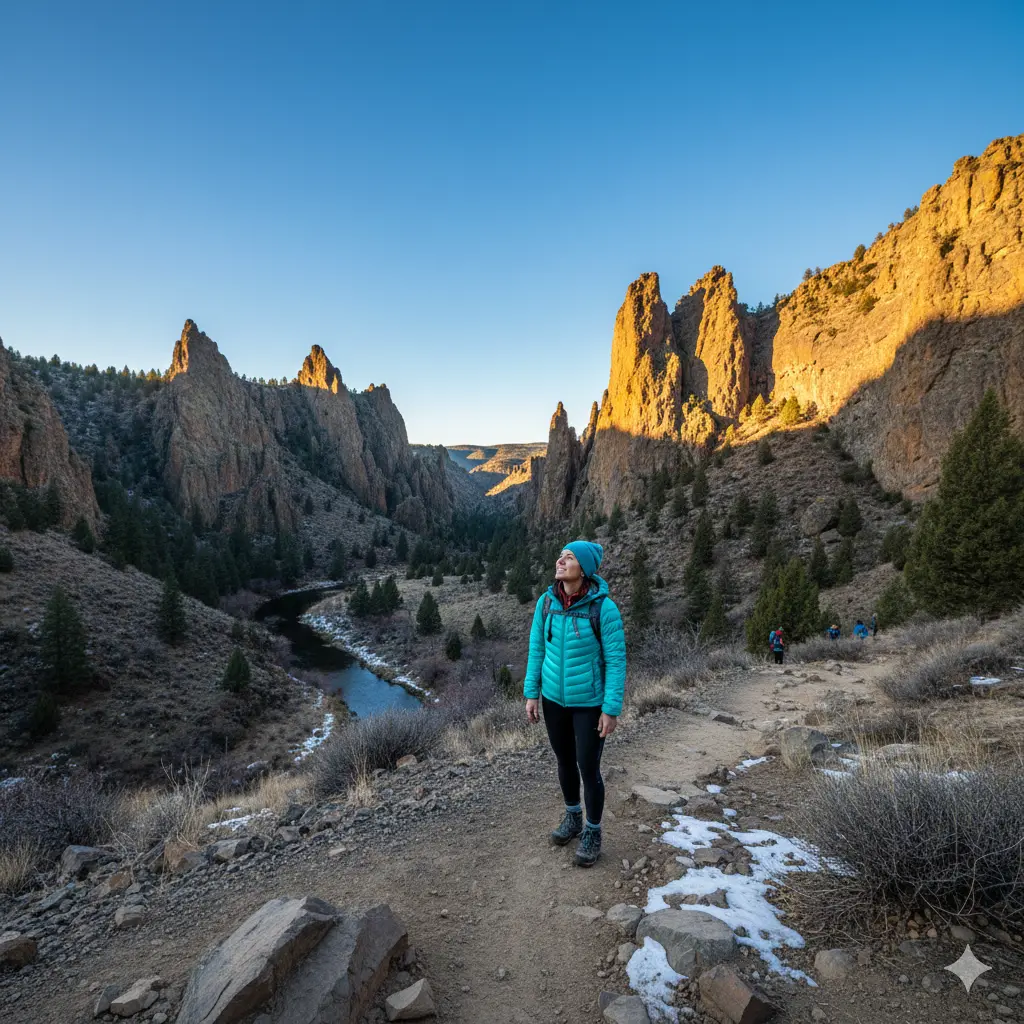
Perhaps the most startling indicator of the 2025/2026 warm winter was the accessibility of high-elevation hiking trails in January. On January 24, 2026, the trailhead to Iron Mountain—a peak usually buried under several feet of snow until June—was reported as entirely snow-free. Hikers were able to summit the mountain with only microspikes and trekking poles, a journey that usually requires snowshoes and advanced backcountry skills this time of year.
Low-elevation favorites like the Oregon Badlands Wilderness and Smith Rock State Park have also seen "summer-level" crowds. These areas, which can be punishingly hot in July and August, are currently offering "perfect" conditions for those looking to escape the gray, rainy days in the valley.
| High-Desert Winter Hike | 2025/2026 Status | Terrain Highlight |
| Ancient Juniper Loop | Open / Dry | Volcanic rock and high-desert tranquility |
| Flatiron Rock | Accessible | Glorious views of the Cascade Mountains |
| Smith Rock State Park | Busy / Clear | World-class climbing and hiking without the heat |
| Steelhead Falls | Clear / Suttle | Waterfall viewing without icy spray hazards |
| Iron Mountain | Snow-free (Jan 24) | High-alpine views with summer-style access |
Data synthesized from regional hiking guides and 2026 trail reports.
Real Estate Market Dynamics: The "Warm Winter" Effect
For real estate agents in Bend, Sunriver, and La Pine, the 2025/2026 winter has provided a unique tactical advantage. Traditionally, winter is a "dark" period for the market, where heavy snow makes property tours difficult and sellers wait for the spring thaw to list their homes. However, the mild weather of 2026 has kept buyer activity steady and allowed for a more continuous sales cycle.
Bend: Balancing Prices and Inventory
The Bend real estate market in January 2026 reflected a shift toward more balanced conditions. The median sale price for a single-family home in Bend fell to $680,000, the lowest since mid-2025. While this might initially seem like a cooling of the market, local brokers point to it as a healthy seasonal normalization. Inventory has held steady at approximately 2.5 to 3.0 months, a significant increase from the "constrained supply" years of 2021-2023.
A key insight for early 2026 is the resilience of buyer demand. In January, while closed sales were lower due to typical seasonality, pending listings actually increased by 13.3%. This suggests that buyers were capitalizing on the warm weather to tour homes and were finding value in a market where they finally had negotiating leverage.
| Bend Market Metric | January 2025 | January 2026 | Year-Over-Year Change |
| Median Sales Price | $734,900 | $707,500 | -3.73% |
| Absorption Rate (Months) | 3.51 Months | 3.0 Months | -14.53% |
| Active Listings | 686 Units | 633 Units | -7.7% |
| Median Days on Market | 57 Days | 78 Days | +36.84% |
| Pending Listings | (Lower) | (Increased 13.3%) | +13.3% |
Data extracted from the January 2026 Key Properties and Beacon Reports.
The "math of moving" has also become friendlier for many. As mortgage rates have dipped into the low 6% and high 5% range in early 2026, the "rate lock" effect is beginning to thaw. Homeowners who were previously unwilling to trade their 3% mortgages are increasingly deciding to move for lifestyle reasons, realizing that the record-low rates of 2021 are unlikely to return in the near future.
Sunriver: The Luxury and Resort Segment
The Sunriver market continues to command premium pricing, driven by its national appeal and quality-of-life advantages. In January 2026, Sunriver recorded a median price of $1.21 million, though this was based on a small sample of three high-end sales. The luxury segment in Sunriver and neighboring areas like Caldera Springs remains robust, as remote-work migration and second-home demand continue to support market strength.
A unique factor in Sunriver is the integration of resort amenities into the real estate value proposition. The Sunriver Resort's 2026 golf opening dates—ranging from April 6 for the Meadows course to May 15 for the Woodlands—provide a clear target for the "spring rush". The mild winter has allowed for continued maintenance and "early-season gravel cycling" on the resort’s 40 miles of paved paths, maintaining the area's appeal even when the ski season is lackluster.
La Pine: A Buyer’s Market Emerges
In contrast to the faster-moving markets of Bend and Redmond, La Pine has transitioned into a more inventory-heavy and slower-paced environment. As of January 2026, La Pine had a 5.4-month absorption rate, indicating a clear "buyer’s lean". The median sales price of $383,500 remains significantly more affordable than Bend, making it a primary target for first-time buyers and those seeking acreage.
However, the "caution" of the buyer pool in La Pine is evident in the time-on-market metrics. The median cumulative days on market (CDOM) in La Pine rose to 113 days in January 2026, highlighting a much more deliberate decision-making process for buyers in this segment. For sellers in La Pine, pricing strategy and property presentation have become more critical than ever, as buyers now have the leverage to be selective.
| Market Comparison (Jan 2026) | Median Price | Days on Market (Median) | Absorption Rate |
| Bend | $707,500 | 78 Days | 3.0 Months |
| Redmond | $499,500 | 45 Days | 1.5 Months |
| Sisters | $670,000 | 98 Days | 3.96 Months |
| La Pine | $383,500 | 113 Days | 5.4 Months |
Data synthesized from regional residential real estate forecasts.
Long-Term Economic and Environmental Outlook
The 2025/2026 warm winter is not just a seasonal anomaly; it is a signal of broader environmental trends that will shape the Central Oregon economy for decades to come. The intersection of "snow drought" and a warming climate presents both challenges and opportunities for the region’s long-term sustainability.
The Wildfire and Water Supply Connection
The primary concern for the summer of 2026 is the lack of a "natural reservoir" in the form of a healthy snowpack. As of February, the Deschutes Basin is in a state of severe deficit, which increases the likelihood of an early and potentially intense wildfire season. Abnormally warm and dry conditions in January have left dead fuels drier than seasonal averages. If the spring months do not deliver significant precipitation, the region may face an early start to the wildfire season, which can negatively impact tourism and air quality—factors that are closely watched by high-end real estate investors.
Furthermore, the water supply concerns impact the agricultural sector and energy production. While a late-season pattern shift in March or April could still bring wetter conditions, the probability of reaching the average peak median snow water equivalent is diminishing as the season progresses.
The Evolution of the High Desert Lifestyle
The resilience of the Central Oregon real estate market despite these environmental challenges suggests a fundamental decoupling of the region's value from traditional "winter wonderland" expectations. Buyers are increasingly drawn to the High Desert for its 300 days of sunshine and its ability to offer high-quality recreation in all four seasons. The shift from a ski-dependent winter to one of hiking, gravel cycling, and year-round accessibility is a testament to the region’s robust infrastructure and adaptive community spirit.
Real estate professionals who can articulate this transition—emphasizing the "lifestyle resilience" of Central Oregon—are finding success in the 2026 market. By highlighting the ability to hike a snow-free Iron Mountain in January while still having access to Mt. Bachelor’s world-class facilities when the storms do hit, they are presenting a more multifaceted and stable vision of the regional economy.
Conclusions and Strategic Recommendations
The winter of 2025/2026 has provided a definitive proof of concept for the "year-round" Central Oregon lifestyle. While the lack of snow has been a significant challenge for the traditional winter tourism industry, it has accelerated a transition toward a more diversified and resilient regional economy.
For the real estate sector, the data from early 2026 points to a market that is finding its footing after years of volatility. Improving affordability, stabilizing interest rates, and a more balanced inventory are creating a healthy environment for both buyers and sellers. The key to navigating this landscape lies in understanding the nuanced differences between the micro-markets of Bend, Sunriver, and La Pine, and in recognizing that the "math of moving" is once again beginning to favor the consumer.
As we move into the spring of 2026, the momentum generated by the mild winter is expected to build. Sellers should prioritize strategic pricing and flawless property presentation to capture the attention of a more selective buyer pool, while buyers should take advantage of the increased inventory and negotiating power that has been absent for nearly half a decade. Ultimately, the Central Oregon real estate market in 2026 is defined not by the snow on the ground, but by the enduring appeal of the High Desert lifestyle—a lifestyle that is proving to be more adaptable and resilient than ever before.
Works cited
- Bend Snow in February: What It's Really Like & Travel Tips - Meredith Lodging, accessed February 21, 2026, https://www.meredithlodging.com/things-to-do/bend-event/bend-snow-in-february
- Snow Drought Current Conditions and Impacts in the West ..., accessed February 21, 2026, https://www.drought.gov/drought-status-updates/snow-drought-current-conditions-and-impacts-west-2026-02-05
- March 2, 2026 Outlook Period – February through May 2026 Executive Summary The signifi - National Interagency Fire Center, accessed February 21, 2026, https://www.nifc.gov/nicc-files/predictive/outlooks/monthly_seasonal_outlook.pdf
- Oregon Housing Forecast 2025–2026: Trends & Outlook - LUXE | Forbes Global Properties, accessed February 21, 2026, https://luxeoregon.com/blog/oregon-housing-market-forecast-2025-trends-prices-and-what-to-expect-in-2026
- Central Oregon Market Report | January 14, 2026, accessed February 21, 2026, https://www.enjoybendlife.com/blog/central-oregon-market-report-january-14-2026/
- La Niña could shape Central Oregon's winter weather, NOAA says - Bend Bulletin, accessed February 21, 2026, https://bendbulletin.com/2025/10/13/la-nina-could-shape-central-oregons-winter-weather-noaa-says/
- Seasonal Climate Forecast March – May 2026 - Oregon.gov, accessed February 21, 2026, https://www.oregon.gov/oda/natural-resources/Documents/Weather/forecast.pdf
- Bend February Weather, Average Temperature (Oregon, United States), accessed February 21, 2026, https://weatherspark.com/m/1215/2/Average-Weather-in-February-in-Bend-Oregon-United-States
- Historical Weather: Bend, United States (february 2026) - PredictWind, accessed February 21, 2026, https://www.predictwind.com/weather/united-states/oregon/bend/february
- February 2026 Historical Weather at Bend Municipal Airport, Oregon, United States, accessed February 21, 2026, https://weatherspark.com/h/m/145276/2026/2/Historical-Weather-in-February-2026-at-Bend-Municipal-Airport-Oregon-United-States
- Snow Drought Current Conditions and Impacts in the West | January 8, 2026, accessed February 21, 2026, https://www.drought.gov/drought-status-updates/snow-drought-current-conditions-and-impacts-west-2026-01-08
- Oregon SNOTEL Snowpack Update Report - USDA, accessed February 21, 2026, https://wcc.sc.egov.usda.gov/reports/UpdateReport.html?report=Oregon&format=SNOTEL+Snowpack+Update+Report
- Oregon SNOTEL Snow/Precipitation Update Report - USDA, accessed February 21, 2026, https://wcc.sc.egov.usda.gov/reports/UpdateReport.html?report=Oregon
- Winter 2025-26 Outlook - National Weather Service, accessed February 21, 2026, https://www.weather.gov/arx/winter2526outlook
- Winter Thrill Seekers Itinerary - Sunriver Resort, accessed February 21, 2026, https://www.sunriverresort.com/thrill-seeker-guide
- Heading outside: Dutchman, Meissner cross-country go-tos, 17-inch ..., accessed February 21, 2026, https://bendbulletin.com/2026/02/19/heading-outside-dutchman-meissner-cross-country-go-tos-17-inches-at-batchelor/
- Mount Bachelor Snow Forecasts for today, 7, 14 and 16 days ahead - 21 Feb 2026 | J2Ski, accessed February 21, 2026, https://us.j2ski.com/snow_forecast/United_States/Mount_Bachelor_snow.html
- Snow report Mt. Bachelor - Skiresort.info, accessed February 21, 2026, https://www.skiresort.info/ski-resort/mt-bachelor/snow-report/
- Snow dumps in store for Cascade passes, National Weather Service warns - OPB, accessed February 21, 2026, https://www.opb.org/article/2026/02/15/snow-dumps-in-store-for-cascade-passes/
- Ski Areas and Sno-Parks - Bend Bulletin, accessed February 21, 2026, https://bendbulletin.com/conditions-report/ski-areas-and-sno-parks/
- Snowmobile Trail Conditions | Wisconsin Snow Report, accessed February 21, 2026, https://www.travelwisconsin.com/snowreport/snowmobile
- Trail Conditions/Grooming Reports - Oregon State Snowmobile ..., accessed February 21, 2026, https://members.oregonsnow.org/grooming
- Trail Report - : Hayward / Sawyer County, Wisconsin - February 12, 2026 - Snowtracks, accessed February 21, 2026, https://snowtracks.com/reports/trail-report-hayward-sawyer-county-wisconsin-february-12-2026/
- Newberry #2 Snowmobile Trail Closure - USDA Forest Service, accessed February 21, 2026, https://www.fs.usda.gov/r06/deschutes/alerts/newberry-2-snowmobile-trail-closure
- Central Oregon Market Report | February 18, 2026, accessed February 21, 2026, https://www.enjoybendlife.com/blog/central-oregon-market-report-february-18-2026/
- Bend, Oregon Mountain Biking Trails - Trailforks, accessed February 21, 2026, https://www.trailforks.com/region/bend/
- Feb 06, 2026 Ben's Trail Trail Report | Trailforks, accessed February 21, 2026, https://www.trailforks.com/report/4449093/
- Phil's (Lower) Multi Trail - Phil's, Bend, Oregon - Trailforks, accessed February 21, 2026, https://www.trailforks.com/trails/phil-s-lower/
- Sunriver, Oregon Mountain Biking Trails - Trailforks, accessed February 21, 2026, https://www.trailforks.com/region/sunriver/
- Wanoga: 3 PSI Trail Map - Bend Trails, accessed February 21, 2026, https://bendtrails.org/trail/wanoga-short-loop/
- Winter Trails - Central Oregon Trail Alliance, accessed February 21, 2026, https://cotamtb.com/wintertrails
- Hike Iron Mountain in Winter for a Wonderful Experience, accessed February 21, 2026, https://www.bendpremierrealestate.com/blog/2026/01/24/hike-iron-mountain-in-winter-for-a-wonderful-experience
- Inspiring winter hikes in Central Oregon - Visit Bend, accessed February 21, 2026, https://visitbend.com/journal/inspiring-winter-hikes-in-central-oregon/
- Market Update - Central Oregon Housing Market - Key Properties Oregon, accessed February 21, 2026, https://keypropertiesoregon.com/market-update/
- Central Oregon home prices and sales dip slightly | The Bulletin, accessed February 21, 2026, https://bendbulletin.com/2026/02/15/central-oregon-home-prices-dip-slightly-home-sales-also-trimmed/
- January 2026 Bend Housing Market Update | Bend Oregon Real Estate - Ladd Group, accessed February 21, 2026, https://www.bendpropertysource.com/blog/january-2026-bend-housing-market-update/
- 2026 Residential Real Estate Forecast - Cascade Business News, accessed February 21, 2026, https://cascadebusnews.com/2026-residential-real-estate-forecast/
- Expert Forecasts Point to Affordability Improving in 2026 — What That Means for Central Oregon - Bend Premier Real Estate, accessed February 21, 2026, https://www.bendpremierrealestate.com/blog/2026/01/15/expert-forecasts-point-to-affordability-improving-in-2026-what-that-means-for-central-oregon
- Oregon Real Estate Market Forecast for 2026 - JVM Lending, accessed February 21, 2026, https://www.jvmlending.com/blog/oregon-real-estate-market-forecast/
- Stay & Play - Sunriver Resort, accessed February 21, 2026, https://www.sunriverresort.com/offers-add-ons/stay-play-golf
Cycling Guide to Sunriver Oregon - Bend Magazine, accessed February 21, 2026, https://bendmagazine.com/cycling-guide-to-sunriver-oregon/